FALCON Tool Ecosystem
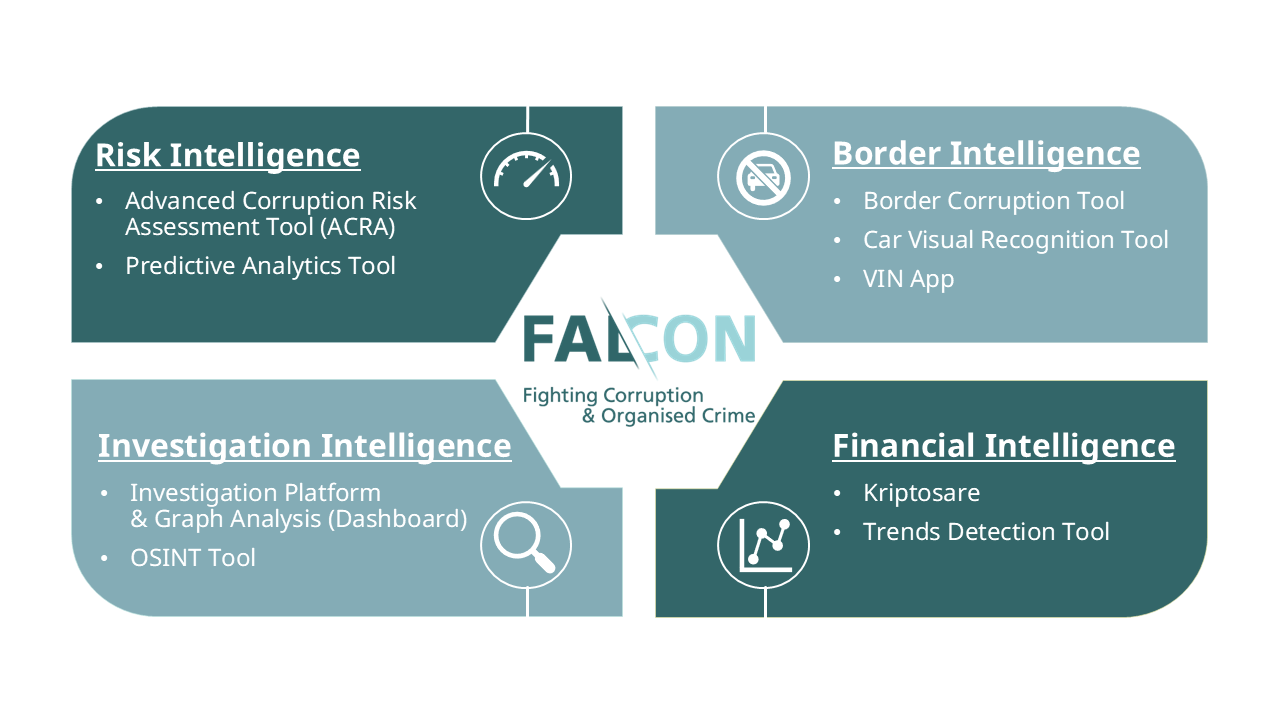
The FALCON Tools Ecosystem is organised into four strategic intelligence domains, each of which addresses a key aspect of anti-corruption efforts:
Investigation Tools
→ Who is connected?
FALCON Dashboard / Knowledge Graph Analysis — all Use Cases
- The FALCON Dashboard is the entry point to all FALCON tools.
- 4 languages: English, German, French, Romanian
- offers investigation through knowledge graphs created upon the FALCON Knowledge Base (KB), consisting of nodes and connections between them (e.g. “Person A” knows “Person B”)
→ making relationships visible & discover hidden patterns - a statistic functionality allows to extract more insights from the Knowledge Graph
- all FALCON tools have read and write access to the Knowledge Base, and it can also be updated manually
OSINT (Open-Source Intelligence) tool — Use Case 1 & 4 – scenario 2, Use Case 3
- supports open-source information collection, e.g. on relationships between people or ownership structures
- sources include news, blogs, PEP lists (PEP = politically exposed person), sanction lists, and EU tenders
- allows investigators to configure the crawler scope, define subjects and search terms, and review structured results that can contribute to broader case knowledge
Risk Assessment Tools
→ Where to look first?
ACRA (Advanced Corruption Risk Assessment) Tool — Use Case 1, 2 & 4
- supports risk assessment and relationship analysis across public procurement, company data and border-corruption scenarios,
e.g., search for and filter tenders, find irregularities, show risk score, search for companies - empowers users to conduct sophisticated risk analyses by exposing risk indicators, search functions, risk assessment views, network-oriented analysis, and geospatial support
Predictive Analytics — Use Case 1 & 4 – scenario 1
- designed to assist LEAs in analysing public procurement processes and identifying patterns that may indicate irregularities, such as single bidding scenarios
- by leveraging data from tenders in different countries, the tool predicts the likelihood of single bidding for a specific procurement lot
Financial Tools
→ Follow the money
KRIPTOSARE Crypto/Fiat — Use Case 2 & 3
- analyses crypto-asset and Fiat transactions to support follow-the-money investigations
- utilises graph analysis, visual analytics and Artificial Intelligence (AI) techniques to extract information and behavioural insights from cryptocurrency addresses/bank accounts based on the transactions in which they are involved
Trends Detection tool — Use Case 2
- supports temporal analysis of cryptocurrency-related activity and receiver patterns
- complements crypto-asset analysis by providing a dedicated entry point for address-based trend investigation
Border Crossing Tools (Use Case 3)
→ Detect suspicious behaviour
Border Corruption Investigation tool
- uses international transit logs to provide actionable insights into border-crossing activities to enhance border security
- leverages predefined indicators (like frequent short visits, always the same border guard etc.) to flag suspicious activities and detect potential criminal networks through data analysis
Car Visual Recognition
- analyses video feeds in real-time to identify the vehicle type and license plates of cars crossing border control points
- license plate, time, lane, and direction is automatically transferred to the Knowledge Base
VIN (vehicle identification number) mobile app
- app for border guards, that decodes the VIN (make, model, year), and checks for stolen status
- the data is transferred to the Knowledge Base, tying VIN to license plate, time, and officer
This video shows how the FALCON tools (Car Visual Recognition and VIN app) are used in the field of border corruption (Use Case 3). It was filmed at the Pilot Event: